Blogs
Beyond NVC
The Difficult Conversations series has set me thinking about how things have progressed since Marshall Rosenberg's day.
So, included in the series is the promising practice of the third chair perspective (which comes from Stone, Patton & Heen, as well as Kinyon, Lasater & Stiles).
In conflict situations there is no shortage of story, and the third chair perspective offers us an antidote to all that story.
But while it is just one of the tools in the modern Difficult Conversation toolkit, it seems to tell us something important about the head shift since the days of NVC.
Imagining AR as a post-individual-centric relational ethic, I want to explore two main threads: evolution from parts to whole, and the regulation value of such tools. Its something like: what the last 30 years of relational technology have quietly been asking of us.
The evolution from parts to whole
The quick start is this: with the third chair practice there is my story, your story and the 'we' story. The third chair is a place especially for the big picture to sit. Or at least our best effort to define it.
To my knowledge the tool comes, not from AR, but from the mediation industry. However AR can not be separated from Ken Wilbur's Integral Theory (at least in the case of the Boulder school). And so the third chair perspective seems a very good fit within the Integral family. The third chair speaks to the individual and the collective, to the behaviour and the experience. It leads us on a journey from ego-centrism via intersubjective spaces, and beckons us toward a wider, less invested view.
When compared with NVC's observation, the third chair story is a much more than just the attempt to describe my story more objectively. The third chair also takes us on a journey from me (or you), to us. It says, we both played a part in this pickle. Stone et al call this the shift from blame to contribution.
The observation step in NVC is pretty good at clarifying behaviors and feelings, but does little to enquire into the relational field, the co-created pattern, or 'dance'. It doesn't ask: whats it like to be us just now? It doesn't ask: what pattern are we up caught in? It doesn't ask: what might a co-regulation inspired synergy look like?
In my opinion, NVC has a world view of two independent actors, maturely negotiating each's 'needs'. The problem is, what if we aren't as independent as was once thought? What is needs aren't as absolute as we once thought? It seems to me that at least some of what we conceived of as needs are projections of our trauma, and other legacy imperatives (residues of asocial reptiles and hierarchical herd mammals, topics for another day).
OFNR says in a very subtle way that my needs are presumed to come before yours, such is the nature of ego. Rosenberg often said that "autonomy is our most precious need". More recent science around attachment and the social nervous system is asking us to reconsider all this.
Instead AR acknowledges that there is a relational field, an intersubjective space where there are areas of shared reality, as well as shared delusion. Where there is nuance, ambiguity and complexity. AR says we might want to take the time to inquire into that field, not only to support the new agenda of connection and collaboration, but for no other reason than for our evolution and growth.
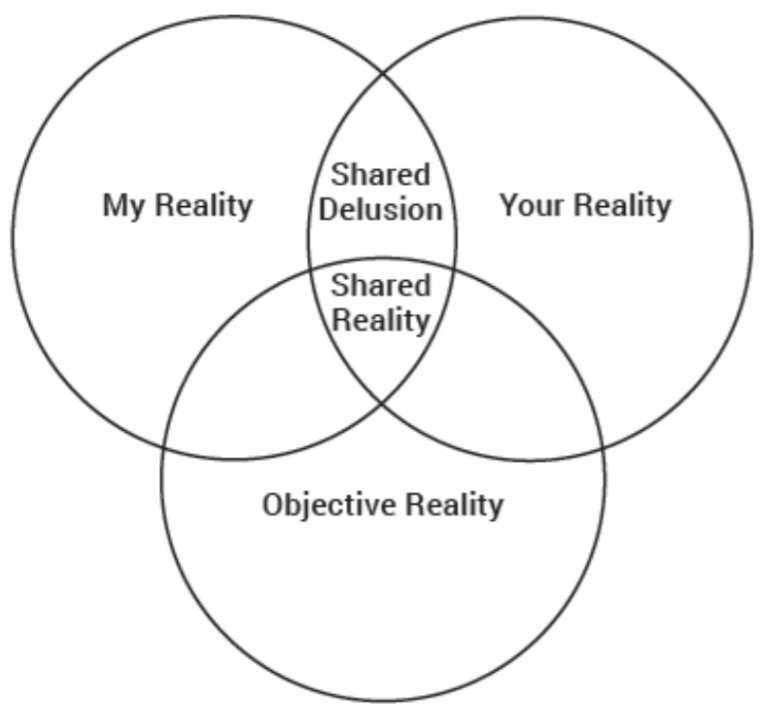
Shared reality is an experience between two or more people in which the understanding of another person's perspective is congruent with the perspective of the person experiencing it.
-- Ryel Kestano
He's talking about really getting their world, and, that the person knows you get their world. And you know that they know. Here he gives an example of a shared reality even within the context of difference:
"I don't agree with you, but I totally get where you're coming from." And the other person might say, "I get that you don't agree with me, but I appreciate that you get where I'm coming from."
-- Ryel Kestano
AR says that: I, you, and us, are all important layers to be honored and appreciated. It's particularly this shift that feels like an important evolution since NVC.
Four fields of convesation
Otto Scharmer also gives us a way to understand this evolution. Theory U has a model called four fields of conversation. It shows that as our capacity to relate expands, we first journey though the first two fields, which are reactive, and backward facing. If we keep going, we 'presence' and turn the corner into field 3. Now i imagine field 3, with its shared love of empathy, to be akin to best practice NVC.
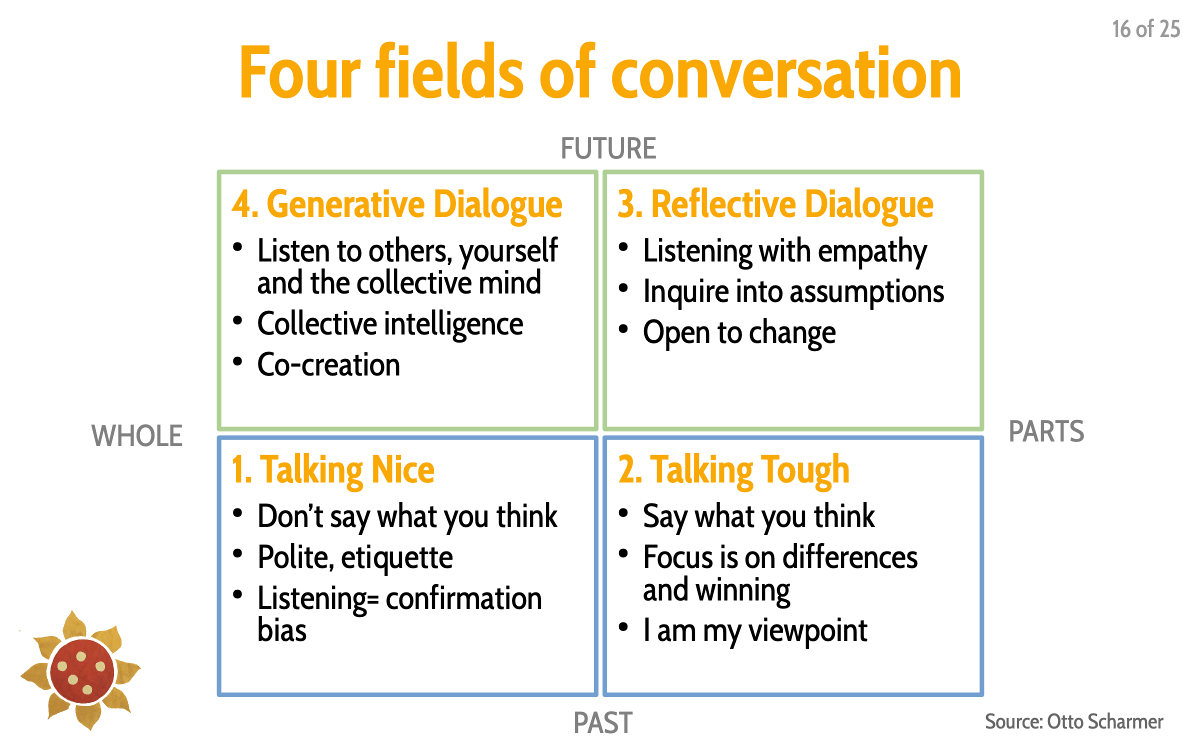
But if we were to travel still further beyond that, we might eventually arrive at field 4. It is future facing, interested in multiple layers and truths, as well as the wisdom of the collective, concerned again with the whole, and of the group mind.
Lets not forget regulation
The other interesting thing about the third chair, is that If i am coherent enough to be able to acknowledge my own contribution, then that immediately tells both of us that i am regulated enough to be having this difficult conversation in the first place.
"It's totally fine to say you did this to me... but i also have to be able to say i did this to you."
- Simon Sinek
Here Sinek's view is that hard to hear feedback should include both contributions. Gottman and Gottman imply something similar with their 5:1 ratio. If one part says or implies that you did this, then five parts get to include things like: this is my contribution, this is what i heard you say, what you say makes sense, could you say more, and i appreciate the way you are showing up for this discussion.
That intentionally cultivated regulation supports my, and their, best possible wise mind, so that somewhere under all my story is a confidence in our cognition, which brings clarity about the reality of each of our experiences, behavior and insight into the overall system.
Obviously part of that truth is that I played a nontrivial part in what happened. Focusing my share on my part, carries the least risk to our regulation. Even though its clear the other person also contributes, speaking of it is tricky to do. I would encourage us to focus first on my part and see what happens.
I recommend being wary of thinking that this is self-flagellation, or a concession to fault or responsibility. Counter intuitively, i have found the practice to be super regulatory. Whenever i have managed to do it, all the fight drains quickly out of me.
Sinek tells a story of how he and his partner were one day each pointing the finger, and how naming their own parts turned the tide on a horrible argument.
You're telling me everything you're doing right and everything I'm doing wrong, and I'm telling you everything I'm doing right and you're doing wrong. Let's just interrupt this and flip the script. I'm going to tell you everything I'm doing wrong and everything you're doing right and then I want you to do the same.
--Simon Sinek
Lets not forget nonverbals
Theres one more thing to be said here, and it's that the words exchanged are only part of the communication.
Stan Tatkin expresses the view, i think aptly, that my nonverbal signalling speaks transparently of my implicit world, and particularly the state of my attachment organisation. While my explicit words can be shaped or shielded, i cannot conceal my visceral micro reactions because they are unconscious and reflexive. "The body always remembers - and the body never lies."
"More than 90% of what goes on between partners at any given time is happening at a nonverbal, procedural, and somatic level. This is particularly true under stress because of the rapid activation of subcortically driven survival systems, which "hijack" parts of the brain responsible for full conscious awareness and contingent choice making."
-- Stan Tatkin
In this light then, I am going to go ahead and perhaps controversially say that judgmental words said with cues of safety are better than textbook NVC said with dysregulated cues.
Does the third chair model give us permission to use judgement words to describe our respective parts? Well yes and no. As we practice this we become more skilful at something that is in many ways unavoidable. I often say that judgment is what the brain does. If i step out onto the road, i have to judge, very quickly and accurately if i have enough time to cross the road before the oncoming car hits me.
On the other hand, we can bring some AR language into our third chair. We can qualify our narrative with stems like, I notice, It seems, Im getting that, Is that right, etc.
This "I" language helps keep the verbals and nonverbals aligned. When our explicit (verbal) narrative aligns with our implicit (nonverbal) narrative, then everything is coherent and consonant. The practice of using owned language also serves us while our perception remains imperfect and a more 'skilful projection' is still developing.
Wrap up
So in talking about the third chair, we talked about the regulation benefits, which alone are reason enough to adopt the practice. Bear in mind that speaking of my part, might not immediately alter the others persons course, straight away, but it will at least not escalate the situation further.
We also imagined that showing the other that i get their world, seems to exercise some transformative shift in consciousness away from fragmented parts to a more generative whole.
As an aside, in town planning law, from my previous life, there is a principle that if all your neighbours agree that your development proposal is sound, then that forms a sort of proxy for it being likely to be environmentally sound.
So in this light, the third chair model as a tool when added to AR, might well be a bridge from the subjective, via the intersubjective, towards if note the objective, then something bigger and more interesting. Something new. Something that only its practice can reveal.
Note that views expressed in blogs do not necessarity reflect the views of the Project. They are the blog authors version of truth.

