Blogs
Hormesis as a lens
This post is an attempt to make sense of chapters 5 and 6 of Baumeister et al., and to explore our recurring question: in sticky moments, which one wins: co-regulation or co-dysregulation? One way to read these chapters is through the lens of hormesis, the idea that growth requires stress, but only within a specific and supportive band.
The previous post concluded that emotions propagate. Including positive emotions, but only in the absence of negative emotions, which propagate much faster and more strongly. I fear that this hints, sadly, that co-dysregulation wins. But lets see if something in these chapters can shed some more light on this important question.
Needing challenge to learn
In chapter 5 the authors explore how negative experiences are necessary for learning. Hellfire works better to get people into churches than salvation. 'No excuses' schools perform better than 'everyone gets a trophy'. Corporate year end penalties motivate more reliably than bonuses.
They go as far as this rather bold assertion: "Students won't learn unless someone points out their mistakes". But then, conversely, at the Fritolay factory, excessively punitive punishment backfires, leading to high staff turnover (and rude notes turning up in bags of potato crisps!).
This seems like a paradox. I get the sense that the authors are speaking about the concept of hormetic stress. ie: there is a sweet spot range of difficult experiences that is actually good for me. By implication, then is there a band of feedback edginess that best helps me grow?
What is hormetic stress?
In biology, the term hormesis, refers to the dose response relationship that organisms have with their environment. For example, too cold and i suffer, too hot and i suffer, somewhere in between there is a Goldilocks like place of 'just right'. Another example is our immune system, which requires exposure to pathogens and other stressors in order to build immunity. One definition of 'allergy' is exactly this, in this hyper clean, chlorinated world, we get much less exposure to immune challenges, and so our immune system is left to invent challenges by becoming allergic to nuts or whatever.
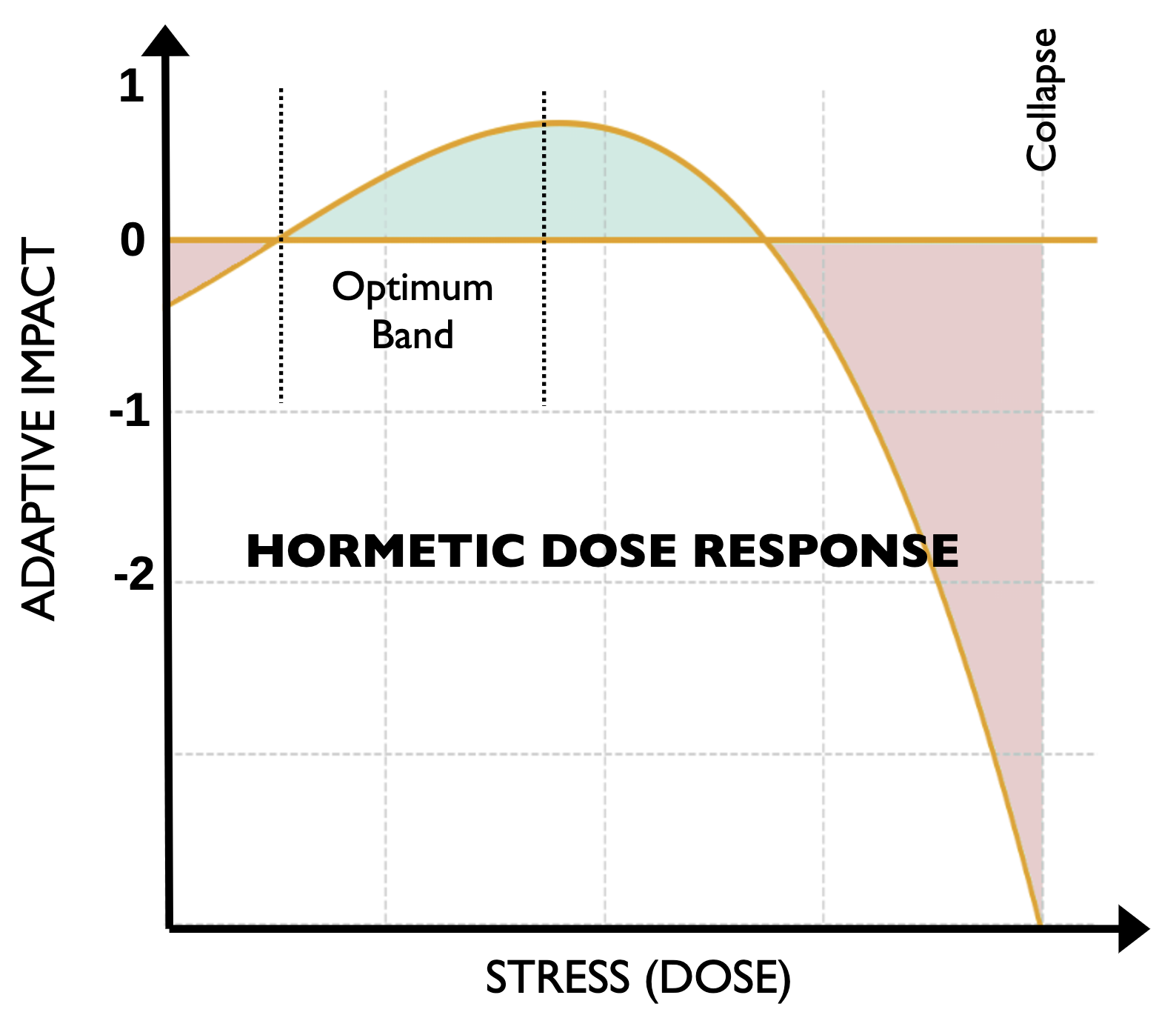
Above is a generalised curve showing the resilience impact from exposure to less or greater stress. Too little stress has a slight negative impact.In very stressful situations the harmful impact increases sharply, as various systems become compromised one after the other, failing in a cascading manner, until eventually the organism dies.
Now in the middle, is this "hormetic" zone. The theory as it might be applied to personal development, suggests that a certain amount of social stress is needed to support our growth, development, and in particular our aspirations toward the evolution of consciousness.
In the model the first half of the green hormetic band is said to be the optimum that supports overall well being. I suppose this is because if further stress fails to produce further benefit, why bother.
So lets cast an eye around for support for the application of biological hormesis to our relational development domain:
- Peter Levine (SE): titration speaks to the idea of healing trauma in small bites. So, don't not attend to it, but don't re-traumatize either.
- Gottman and Gottman: maintain a high ratio of positive experiences to negative experiences. The idea of a bank account of emotional goodwill, that their lab data shows, when kept out of the red, allows us to sustain relationships which we would otherwise find more challenging than we have capacity to hold.
- EFT, we get better at managing emotion primarily through dyadic emotional experiences. This implies that some stressful moments are involved!
- AR, which tells us that practice is king, ie. no amount of book learning will help me communicate better. Through practice i bump up against my edges, and by embracing that discomfort, (the thorn), i get to explore my potential (the bud).

Cold plunge, aka ice bath therapy, is an example of a hormetic stress protocol
Co-dysregulation verses co-regulation
Chapter 6 extends the argument to teams. Negative emotion is contagious; dysregulation spreads faster than regulation; one emotionally disorganised member tends to set the tone. The book's "rule of four" states that avoiding one unit of dysregulation is always more effective than trying to offset it with four units of positivity.
They further touch on:
- A team of 'emotionally stable' people generates many more creative ideas
- The presence of "one particularly wonderful team member" does not offset an emotionally disorganised team member.
- There are similar but different impacts from both mobilised energy and immobilised energy
- As far as emotional stressors go, "social rejection is uniquely stressful".
At the back end of the chapter they discuss their 'bad apple' metaphor, which i am not really getting. It treats the individual as the cause rather than the symptom. Sir Albert Howard's pioneering organic farming research in the 1920s, offered a radically different frame: that pathogens hit plants hardest when the soil is depleted. In that sense i would argue that the problem is not the apple, but the orchard. For which we need look no further that the dysfunctional way that children have historically been raised in this society.
Ok, so does co-dysregulation beat co-regulation? Or does context matter? The final paragraph of chapter 6 offers us a clue:
"But no matter how much trouble [an upset apple] causes, be kind. It wasn't just their fault."
Yes, so perhaps the real message might well be that the outcome depends less on who is or isn't upset that particular day, but about the responsibility or lack thereof for setting and maintaining that context.
To me, context does matter. And part of that context includes defining the hormetic stress range of the container.
Recognising as we do the disproportionate impact of negative experiences, then creating a container where dysregulation beyond the band is best avoided. And when dysregulation does show up, we have a plan to co-regulate it.
Individual v common hormetic range
As we contemplate creating a container with the Goldilocks amount of relational stress, the question becomes what range? whose range?
Each member of a team arrives with their own window of affect tolerance, their own trauma load, their own preferred relational intensity and appetite for shadow work.
You cant play any kind of sport where there is no agreement on the amount of craziness that is 'fair game'. So, I am imagining that groups get called to define a single shared hormetic range, at the level of the container. This band is less determined by the average of the members' bands, but more by the level of stress the context holders can reliably hold. Just the same as, i wouldn't go to a therapist that couldn't hold my trauma.
Context matters
Groups can either evolve the container to fit the team, or assemble a team to fit the container. This project has, i think that much is clear, adopted the latter approach. Hence the "strong" contexts: clear guidelines, shared language and relational practice framework.
There are edgier practice communities like circling for those who want less context, and, there are less edgy domains, like therapy or yoga, for those who want more context.
Appreciation defines the band
As i write this i've just realised that, given the rule of 4, appreciation (and the cues of safety that come with it), really matters to staying in the band. As we craft our feedback guide, I'm tuning into this: any desire to be able to exchange "challenging" feedback has to be founded on top of our capacity to offer unhesitant, specific, and genuinely enthusiastic appreciation, complete with cues of safety. When we have mastered the four, then there's so more space for the one.
I have no idea how many more posts this darn book will take :)
Read more.
The topic of hormetic stress seems to be trending, In addition to Antifragile etc, there are at least two brand new books on the subject:
- The Hardiness Effect: Grow from Stress, Optimise Health, Live Longer (2025), Paul Taylor
- The Stress Paradox: Why You Need Stress to Live Longer, Healthier, and Happier (2025), Sharon Horesh Bergquist
Note that views expressed in blogs do not necessarity reflect the views of the Project. They are the blog authors version of truth.

