Blogs
The biochemistry of leadership
Here I want to explore the biochemistry of leadership. This means we have to talk about dominance and submission. We have to talk about dated notions of status and leadership. We have to talk about serotonin.
Faced with the residues of patriarchy and capitalism, there are today aspirations of more benevolent leadership. Terms like servant leadership, and natural or creative hierarchies are in vogue. Without doubt, the likes of Greg Chapman, Garry Ridge, Jos de Blok, Dennis Bakke, and others are doing fantastic things in the corporate world. Agile small teams are proliferating, managers serve as coaches, and staff at all levels are being given decision making authority and ownership stakes.
However i tend to a view that we need more than a different breed of leader, but an understanding of the biochemistry of leadership and social status.
The biochemistry of social status
There is a body of science that relates to social status. In the 1970s when primate experimentation was still a thing, landmark experiments at UCLA placed vervet monkeys on each side of a one way mirror. The alpha monkey could see it's subordinates, but they could not see him. When the subordinates failed to show their usual deferential behavior, the alpha monkey's serotonin levels plummeted. Further tests went on to reveal a causal relationship between social importance and serotonin, and the results were widely published in major medical journals.
What followed was a push back against lab testing on primates, however truth be told i suspect this was all too much of an inconvenient truth for the prevailing power structure of our world. Instead to this day we have only a narrative based on a pathology of randomly low serotonin. The medical industry would simply have us keep taking our SSRIs. Indeed in my country fully 25% of middle age women are now taking such drugs. Worse still reportedly the biggest growing market in anti-depressants is in the young. These drugs artificially raise serotonin levels by inhibiting re-uptake.
An evolutionary explanation
In polite society, it is unpopular to acknowledge that social dominance feels good. But there are perfectly sensible reasons why this is indeed so.
It's thought that humans evolved by promoting the fitter and stronger individuals to positions of leadership. All mammals do this, so that the higher ranked individuals get better access to food and mating opportunities, so as to better pass on the DNA of traits considered beneficial to the group's survival.
Serotonin is understood to be a hormone that promotes feeding and digestion (that's why most of it is made in the gut). Whereas reptiles produce large number of offspring, and have little concern for their infants (often seeing them as food), mammals are all about the survival of groups, not individuals. Mammals have so few babies that they must keep more of them alive. Its why we go gaga at our friends babies. Without social hierarchy and serotonin, each individual would simply lunge at food, trampling the vulnerable juveniles and other physically weaker but otherwise useful members of the group.
Serotonin exists in all animals. In 12 rules for life Jordon Peterson describes the way lobsters use it to establish territory. Lobsters social system is much simpler than ours. Basically if an individual you encounter is bigger, stay away, if its smaller eat it and take it's stuff.
Low-ranking lobsters produce comparatively low levels of serotonin. This is also true of low-ranking human beings. Low serotonin means decreased confidence. Low serotonin means more [vulnerability] to stress... Low serotonin means less happiness, more pain and anxiety, more illness, and a shorter lifespan - among humans, just as among crustaceans.
-- Jordon Peterson
Later came interesting studies like the very large Whitehall study, which showed that the higher your position in the government machinery, along with the higher salary came greater job satisfaction and better physical health. In other words the higher your serotonin levels.
Mammals seem to have higher serotonin levels when they rank higher in their group's hierarchy. You might presume that high serotonin levels cause high status, but research points in the opposite direction. High status seems to cause the high serotonin.
-- Loretta Breuning
What is the lesson?
In his book Leaders eat last, Simon Sinek calls serotonin the leadership chemical:
Serotonin is the feeling of pride. It is the feeling we get when we perceive that others like or respect us. It makes us feel strong and confident, like we can take on anything. And more than confidence boosting, it raises our status.
-- Simon Sinek
In short this (semi-buried) body of science says, higher social dominance increases the feel-good neurochemical serotonin. Lower social importance and status lowers serotonin and increases cortisol. This doesn't feel good. And because serotonin, re-uptakes very quickly, this is something that requires constant reinforcement.
Consequently it is no surprise that every human is constantly in pursuit of some sort of social status. Regardless whether we are wealthy tech billionaires or poor student activists. Regardless of whether we think this to be a good or bad thing.
With the fall from grace of aristocracy and patriarchy, humans have tended, as did our primate predecessors, to offset social dominance with the forming of social alliances, and a measure of philanthropy and care for the vulnerable. Just enough to serve our purpose and appease our conscience. In humans, oxytocin is employed alongside serotonin in our quest for a social order that is less overtly dog eat dog. We want to be seen to be doing the right thing. At least in our in-group circle.
Knowing all this, Loretta Breuning PhD, whose books inspired my thinking on this subject, concludes two things:
1. that those of us who are motivated to creating flatter, more equitable organisations must be constantly watchful for our relentless and unconscious drive for social dominance
2. that as we aspire to evolve into more consciously collaborative human beings, we need to find other ways to raise serotonin besides social dominance. You can not fight serotonin, it will always win.
Integral Theory and organisational evolution
Frederick LaLoux's seminal book Reinventing Organisations surveys changes in the way humans have structured their collectives over time. It's a book i tend to reread from time to time, to get my bearings. Laloux leans on the insights of Ken Wilbur, as well as numerous other developmental theorists.
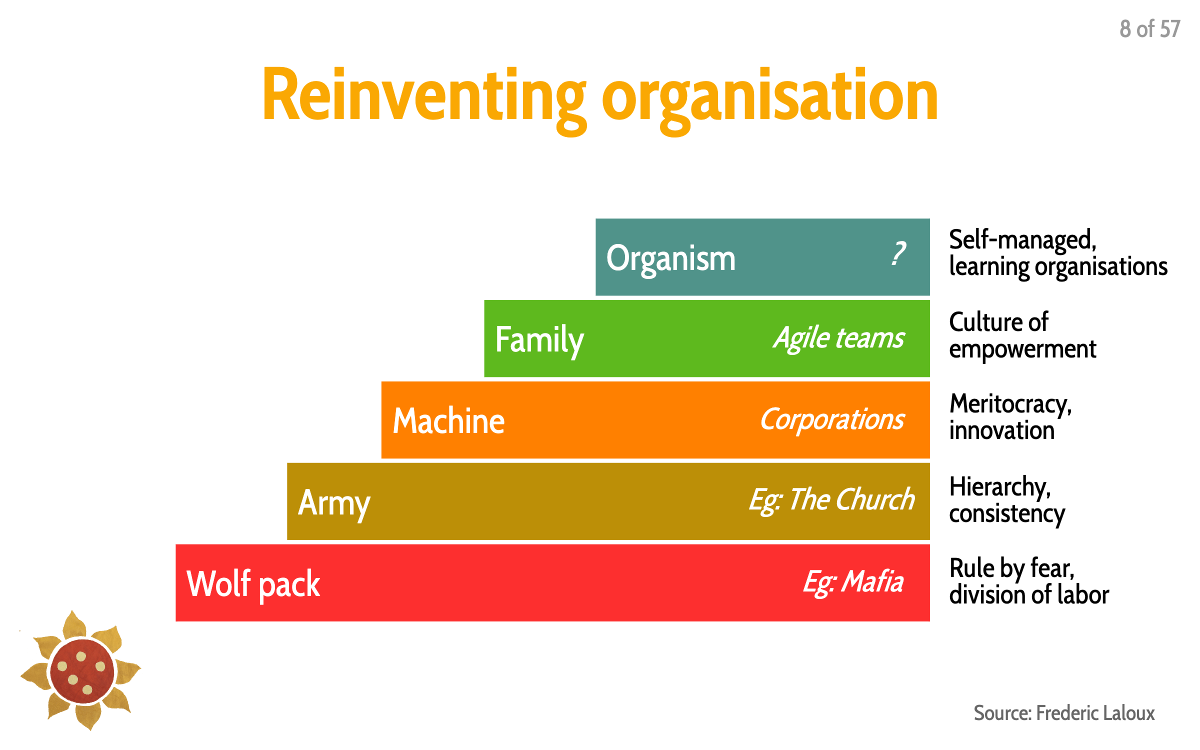
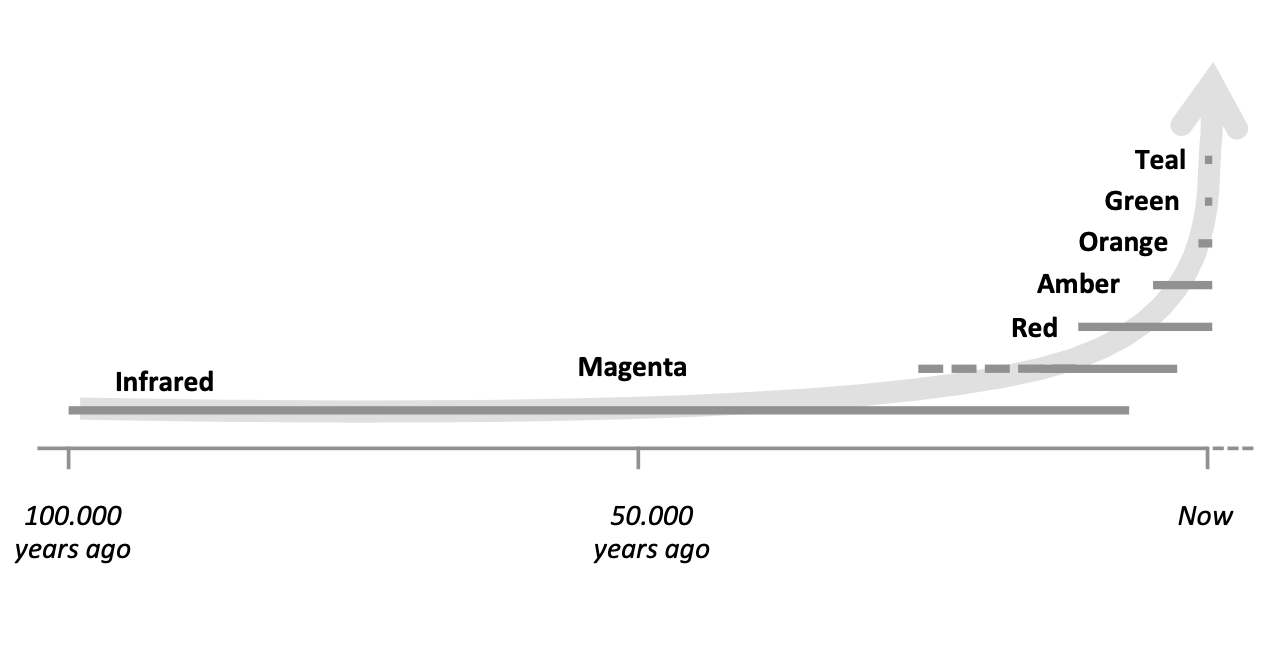
His view is that our consciousness has risen rapidly during recent millennia, and as a result we are forming ever more sophisticated and capable type of organisation. But until Teal, we were just shuffling deck chairs.
- Red: is the wolf pack, or mafia. Unfettered social status, chieftainship, rule by fear, reactive and not future looking. Division of labor
- Amber: is the army or church. Formal pyramid hierarchies. Top down command, roles, processes, stability above everything
- Orange: is the age of the machine, of corporations. Innovation and growth are new imperatives. Meritocracy and accountability arrive.
- Green: is the family. Culture and purpose driven. The empowerment and wellbeing of everybody in the team.
- Teal: is of the organism. This is the bleeding edge. Likely involves the dispersion of power and responsibility, consideration of the whole environment, and vastly transformed communication
Ok, so what does Teal tell us then about leadership and social status?
Nearly always, the backdrop of that [cutting edge management] literature is a traditional (Amber/Orange/Green) organization...
With green and teal, CEOs are giving up their top-down hierarchical power. The lines of the pyramid no longer converge toward them. They can no longer make or overturn any decision. And yet, in a time when people still think about organizations in Amber, Orange, and Green ways, the CEO has a critical role in creating and holding a Teal organizational space. But beyond creating and holding that space, paradoxically, there is not much a CEO needs to do; he can let the self-organizing, emerging nature of Evolutionary Teal take over.
-- Frederick Laloux
What i hear Laloux describing is leadership as holding space for the development of Teal culture. However this can come from anyone within the organisation. "If many people in an organization have grown to a Teal perspective, there are that many more people who can hold the space."
Teal's three breakthroughs
Self-management: Teal organizations operate effectively, even at a large scale, with a system based on peer relationships, without the need for either hierarchy or consensus.
Wholeness: Teal organizations invite us to reclaim our inner wholeness and bring all of who we are to our work, both our rationality, determination and strength as well as our emotional, intuitive, and spiritual parts.
Evolutionary purpose: Teal organizations, instead of trying to predict and control the future, members of the organization are invited to listen in and understand what the organization wants to become, what purpose it wants to serve. This purpose transcends the frames of leaders' desire or self interest.
In Teal, we can transcend judgment and tolerance. In earlier stages, when we disagree with other people, we often meet them in judgment, believing that we must be right and they must be wrong... Or we can, in the name of tolerance, the Green ideal, gloss over our differences and affirm that all truths are equally valid...
In the [Teal] absence of judgment, relationships take on a new quality. Our listening is no longer limited to gathering information so as to better convince, fix, or dismiss. We can create a shared space safe from judgment, where our deep listening helps others to find their voice and their truth, just as they help us find ours. In Orange, we broke free from the oppressive, normative communities of Amber. Now we have a chance to recreate community on new grounding, where we listen each other into selfhood and wholeness.
-- Laloux
And to return to our serotonin theme:
When I first became an entrepreneur and a CEO, I realized how addictive that role was. You get to be a hero every day... One of the challenges and opportunities... is now everybody else gets to be a hero too... That's an interesting struggle. It removes some of the addictive quality of power, of being that guy at the top ... and yet ... how great is that for the organization when it's full of heroes instead of resting on just one at the top
--Brian Robertson, quoted by Laloux
Our desire for leaders
One of the road blocks to building more leaderless / leaderful organizations is my own desire for heroes.
The corollary of status seeking behavior (which explains the building of empires) is a gravitation to saviors (which explains cults). I suspect that most of us would secretly admit to quite liking the idea of a charismatic someone to come along and save us (from whatever foes we imagine we are facing). Speaking for myself that desire feels like some small old part. The part that was let down by the people who were supposed to be watching my back. When i was not yet mature enough to do that for myself.
In this vein, I imagine it might be tempting to hold the founders of this or any project up as leaders, "people that should know what they doing", and whose behavior matters more than average. Behavior that should somehow be exemplary.
To be honest this terrifies me. Why? Because i don't want to be anyone's leader. Because i am as fallible as the next person, i am as traumatized as the next person, i am a work in progress, just the same, as, the, next, person. I will make mistakes. I will screw up, i will use unowned statements, and i might even snap at somebody who i think is criticizing me.
Speaking from my perspective, it feels alive to say that my role as a leader starts and ends with this:
- To the extent that i was part of the group that constructed the context, as it is outlined in the Vision Booklet and the PPPs. That context now has to stand on its own, i have no more or less say in its future than any other member. That context, among other things, says that while the context is constitutionally enshrined, it is not unchangeable. While that context forms a foundation, there is the chance to add or change things. And there is a documented process to do exactly that.
- To the extent that i am part of a group that believes in distributed leadership, where leadership is more of a personal quality, rather than any kind of role, then, yes, i am a leader, just like everyone single one of us here is also a leader. If we are tuning into what is calling to be birthed into existence right now, that makes us leaders.
In the Vision Booklet's own words:
"We might also notice our heroic notions of leadership, where a magical someone will charge in on a white horse and save us." p5
"When there is a leader in every chair". p13
The role of founders
Perhaps in order to appease his orange and green leadership innovation audiences, Laloux, doesn't entirely let go of the CEO or founder's role. And many of his examples showcase the coach slash vision holder slash change catalyst role of such people.
There are those such as Peter Koenig who insist that vision weighs heavily on a single individual's shoulders, and that they alone are responsible for it's clarity, and developmental coherence. Defining what is in, what is out and what is the next step. This seems very Steve Jobs to me.
To the contrary all the long lived collectives i have been involved with started with 2 or 3 founding members, not more, not less, This is because a single person can have some whacky ideas that don't reality test. More than three offers too rich a diversity, the integration of which requires more group / facilitation skills than the fledgling group yet possesses. In this model the founders' role starts and ends with comprehensively and accurately documenting their vision, mission and values. Others can then align around that vision, and subsequently the founders have just as much responsibility for upholding and developing that vision as any other team member.
To the degree that the articulation of the vision wasn't adequately clear, or that team members' understanding of it is incomplete, the resulting misalignment may mean founders will find themself with an elevated sense of responsibility to course-correct, as a transitional work around. It seems that, top down, bottom up, no system is, or ever will be perfect.
A metaphor i like is how a single pair of fetal stem cells effectively casts in stone the vision for the mature adult human. That vision gets stored in every single cell that divides off the base pair, in the form of DNA. Each final cell has specialised capacities, but communicate using multiple overlapping networks. To my mind that is a creative hierarchy but not really an operational hierarchy.
Practice
The other thing that leadership theorists speak little of is practice. This is the idea that capacity doesn't magically appear, just because we want it, dream it, or learn about it. I suggest that we evolve from where we are, to where we aspire to go, with intention firstly, then a rigorous commitment to practicing the skills. Instead of saying, well collaboration, and dispersing leadership are too hard so lets just parcel out responsibility for vision and emergence into separate gifted bundles using a 'natural hierarchy', we say, yes our collaboration and broad based leadership skills suck just now, but by laboring over the practice, we become better at it.
For me personally, charisma is certainly not a strong suit, nor do i have much inclination toward saving anyone. No amount of practice will fix that. However becoming better equiped to offer cues of safety, genuine appreciation, and to support others to succeed within their own frame of reference, all seem like useful edges.
Laloux identifies onboarding and training as important practices for aspiring teal collectives. Of course AR is a kind of training, but only in so far as we engage with it repeatedly, and don't try to treat it as a nice wellbeing experience that we merely consume.
Other paths to serotonin
To summarise Breuning's theory, having the respect of our peers elevates serotonin, which feels good, and promotes health and well-being. Fortunately the professor is also of the view that we can raise our serotonin levels without dominating others. Her tips:
- Savour the influence you already possess
- Make peace with things you cant control
- Express pride in your smallest achievements
- Master a skill
- Build social alliances
- Contribute to a cause
- Celebrate each others strengths
Now that i read that list, isn't that what the project is trying to do?
Stand up straight, with your shoulders back... Speak your mind. Put your desires forward, as if you had a right to them... Encourage the serotonin to flow plentifully through the neural pathways desperate for its calming influence.
-- Jordon Peterson
By finding our passion and focusing our energy on mastering it's skills and achieving milestones toward its excellence, we in essence gain the respect of ourself. We feel important by being important.
And here we see the A word appear yet again. What is appreciation if not making others feel important. Knowing the hormonal benefit, knowing it upwells from an inexhaustible fountain, why ration it like there is not enough to go around? If offering appreciation feels like an act of submission, try considering it a short term loan.
Appreciation as a sustainable resource that literally powers collaboration.
Reading
- Loretta Breuning (2021), Status Games
- Loretta Breuning (2023), I mammal
- Frederic Laloux (2023), Reinventing Organizations
Note that views expressed in blogs do not necessarity reflect the views of the Project. They are the blog authors version of truth.

