Blogs
Agency, a choice or a practice?
In AR we have a half dozen or so expressive stems: i notice, i imagine, i think, i feel, i sense, i wonder, i want. However, it seems to me that in order to bring our desire into the world, we need one more. And that is: something that declares my self-authorship or agency.
Sure, we have consent and boundaries, but they are a response to something. I am guessing that we need something that is overarching and also proactive. Something that means: I decide. I enact. I discern and act upon that discernment. Something that brings my desire into the world. As in, "I choose to not drink alcohol tonight". "I choose partners who are willing to repair".
In a similar way that revealing my desire serves many of the functions of a request, perhaps an "i choose" declaration also serves the functions of consent.
Personal agency
The contemporary definition of the word agency is something like: the capacity to perceive one's experience, make choices, and act in alignment with one's values and intentions, independent of external coercion.
The word agency only came to be used in this way (rather than an office or department) since the publication of Anthony Gidden's treatise The Constitution of Society in 1984. Now it's rapidly on the rise.
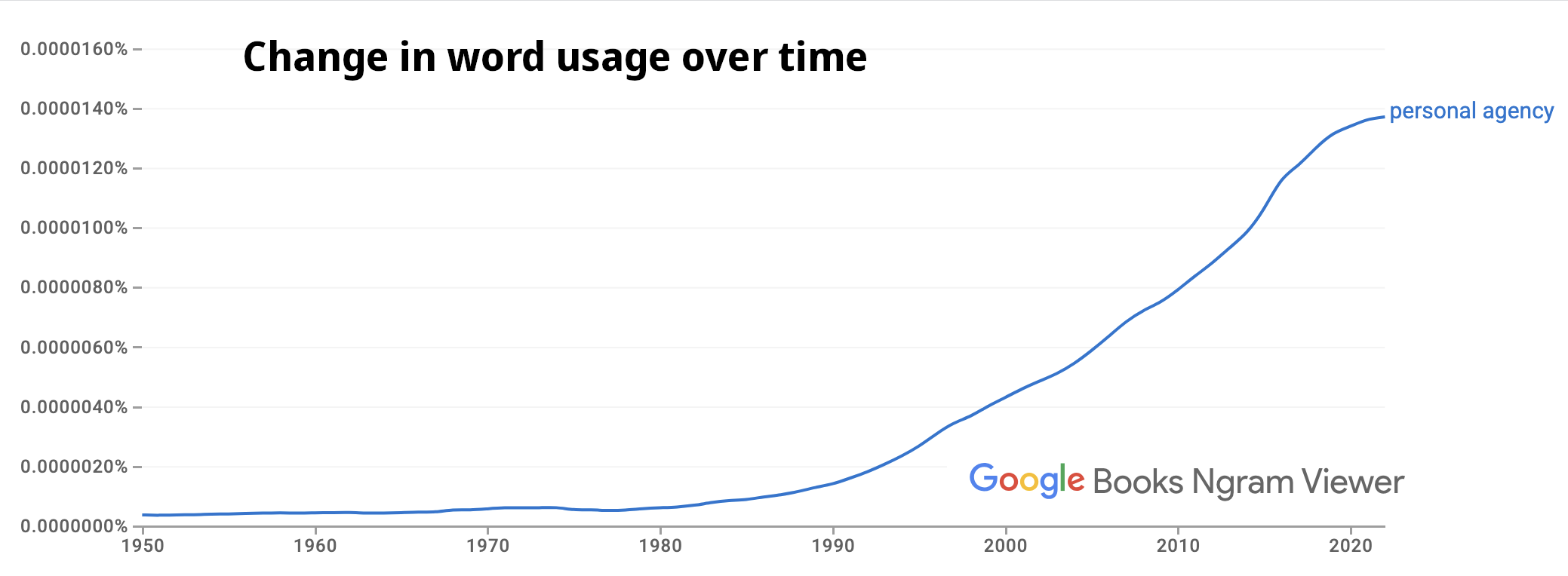
For the rest of us, we probably need a nicer word. Unfortunately the English language is not replete with options. The most suitable of which to my mind is 'choice', and the verb to 'choose' (although it's not perfect because it hints at fixed options).
Just as "i desire" was hiding in plain sight for me personally, given my trauma background, waking up one day last year to realize i can shape my world, hold myself and others accountable, and choose whom i engage with, was eye opening.
I am assuming that agency gets lost (or never gained) at the exact same time and place, right along with its sidekick desire. In the attachment sense, disrupted development, unmet childhood needs. If choice is both pointless and painful, who has further need of it? There goes my sense of agency, self-authorship and decision making. The world then is something i can only protest or try to control beneath the radar.
And, it seems that i am not alone in my obliviousness as to having lost this important trait. There are literally millions of self help books, and of those, hardly any are specifically about personal agency. Those i found are either dense academic texts, or those from the 'just do it' motivational genre.
Which seems odd, considering that freedom, liberty, and autonomy are central preoccupations of modern life. That narrative is everywhere, albiet implicitly, albeit mostly in the form of a reaction to things i perceive to be beyond my control. None tell me how to build that capacity in the first place.
I would say that an actual discussion about agency and its restoration as a societally important developmental edge is indeed quite timely.
The literature
Below is a sampling of some of the books that do manage to circle agency, even if they do not directly touch it.
Jordan Peterson speaks of agency as a moral responsibility. The title says it all: 12 rules for life. Stand up straight with your shoulders back. Tony Robbins speaks of agency as sheer decisive willpower. Stephen Covey, and James Clear on productivity hacks and habits. Angela Duckworth speaks of agency as sustained effort and grit. In the military arena, Goggins, Willink & Babin speak of agency as radical responsibility. And into the realm of spirituality, Viktor Frankl speaks of agency as the freedom to choose your attitude, and Eckhart Tolle as a call to adopt awareness and presence.
The common thread here is that we should all 'just' be more self authoring. The implication is that our agency is sitting there intact, we just need to be reminded to use it. But in cases where early development interrupts the formation of stable authorship, such advocacy can feel unattainable, and instead just trigger shame.
What if we instead were to say, gosh it makes sense that our agency feels a bit offline or foreign, given all that happened to us. But hey, it sounds kinda wonderful, shall we try it, together, in baby steps?
If agency is a relatively new term, and our capacity for it still in its infancy, that could be for many of the same reasons that our capacity for consent and being able to ask for what we want, is also edgy.
Again the reasons are not hard to find. Simply put, agency, historically, was the prerogative of royalty. The sovereign right of kings to rule over states and nations. Ordinary people had no need of agency. What debate did occur was confined to the dusty religious philosophy volumes on questions of free will (or not), divine providence and the determination of all things.
Cynically speaking, the self-help industry, could be said to benefit from agency not being too closely examined. So many books and courses to sell to me when i can not locate and act upon my own sense of what i want. I remain forever dependent on someone else's version of reality, of someone else's agency.
Ronald Purser's McMindfulness, and Robert Masters Spiritual Bypassing have long expressed concern about the practice of personal growth without attending to the underlying pain. The likes of Christopher Lasch, and Mark Fisher take this further and criticise personal growth as a substitute, or pacifier for, the work of confronting class oppression and systems of domination, like capitalism, patriarchy, and white supremacy.
These critiques speak to the idea of the 'social construction of the self'. In other words: is our lack of agency programmed into us at an early age, in order to perpetuate social class? This is even further developed in such disruptive works as Vannessa Andreotti's Hospicing Modernity, where the work is essentially to decolonize yourself and each other.
But in the popular realm, this relative silence on the matter of agency, i find rather vexing. Sure, "be the author of your life" saturates modern culture, but this is not the same as true developmentally informed agency., or knowing how to get it.
I will also raise one other important caveat regarding agency, from a relational point of view. Now that we have worked so hard in the post war decades to crystalize our sense of individuality, agency must not be a snap back to a purely solitary agency. Doing this risks taking us right back to hero narratives, hard line personal sovereignty and moral superiority. Agency must transcend and include, it must somehow keep it's new relational context.
Building capacity
What i have a desire to see examined is, HOW capacity for agency can be built.
Of the domains covered by the books i mention above, it is probably the military that most gets the idea of practice. Sinek explains at length the way that US marines are trained. NASA and the aviation industry in general works similarly. Utilizing simulation and repetition, drills are repeated until they become reflexive. They call it muscle memory. Simulation, is about practicing in controlled conditions before exposure to the full risk of real life.
That's why Willink's formula, with all his "just man up" bravado, seems more actionable than most, because his audience has already bought into the practice agenda. However, while the military understands the value of practice, they still cling to the idea that there is someone to provide that training, some expert or 'leader'. Someone who defines the practice. Someone who determines what counts as correct. In that sense agency is still outsourced.
Surely, we need both to practice, and to practice the practice of agency itself. In other words to agentically choose to practice being agentic :)
There remains unmentioned one notable beacon in the agency literature, standing out from the ra ra, and that is Robert Kegan. He gave us agency as a developmental milestone arrived at in a sequence of steps as a product of being in environments that hold a mixture of support and challenge. No surprise that Kegan (along with Wilbur) are philosophical godfathers of (Boulder School) AR.
Wrap up
Lets see if we can bring this home. "I choose" is embodied authorship. "I choose" is a self-directed practice loop that builds agency from the inside out. My full whole sense of self is practiced into being through the desires i name, and the choices and decisions i enact.
I don't need an external trainer, the practice itself informs my growth. Everyone can practice it, regardless of education, age, income, or social position. No expert is required, however relational mirrors and contexts are. Practice generates competence AND autonomy simultaneously, unlike conventional training, which usually produces only competence. Tell me what i should learn.
The AR approach feels completely different because we can use growing agency to power growing agency. I choose to do practices that exercise my sense of agency. I desire and choose to do that with the support of my practice community because that is how i learn best. In this sense AR is a tool to recover authorship through communication practice.
This extra stem "i choose" is a way to complete the circle of all the other AR stems. If this is so, then AR is the practice of building capacity for broadly distributed interpersonal agency.
Reading
Everything you ever wanted to know about seizing the reigns (not really!)
- Jordan Peterson, 12 Rules for Life
- Stephen Covey, The 7 Habits of Highly Effective People
- Tony Robbins, Awaken the Giant Within
- Jocko Willink & Leif Babin, Extreme Ownership
- James Clear, Atomic Habits
- Angela Duckworth, Grit
- Viktor Frankl, Man's Search for Meaning
- Eckhart Tolle, The Power of Now
- Robert Kegan , The Evolving Self
Note that views expressed in blogs do not necessarity reflect the views of the Project. They are the blog authors version of truth.

