Blogs
Laughter and learning
What exactly is laughter? Greg Bryant says laughter in humans is a repeating sequence of glottal sounds each made on the exhale.
"There is usually an initial onset that's louder than the rest and there's a slight decay in the volume. And then you have these calls where basically there's a glottal cycle, meaning that the glottis, which is in your larynx that opens and closes, when it closes, the air gets forced through, and then vibrates and that makes the tone. And when it opens, then just air goes through and then you don't hear that as a tone. When the glottis closes, then you actually get this fundamental frequency, which correlates to a pitch and then it opens. And so basically a laugh is this rapid opening and closing of the glottis, and it is involuntary."
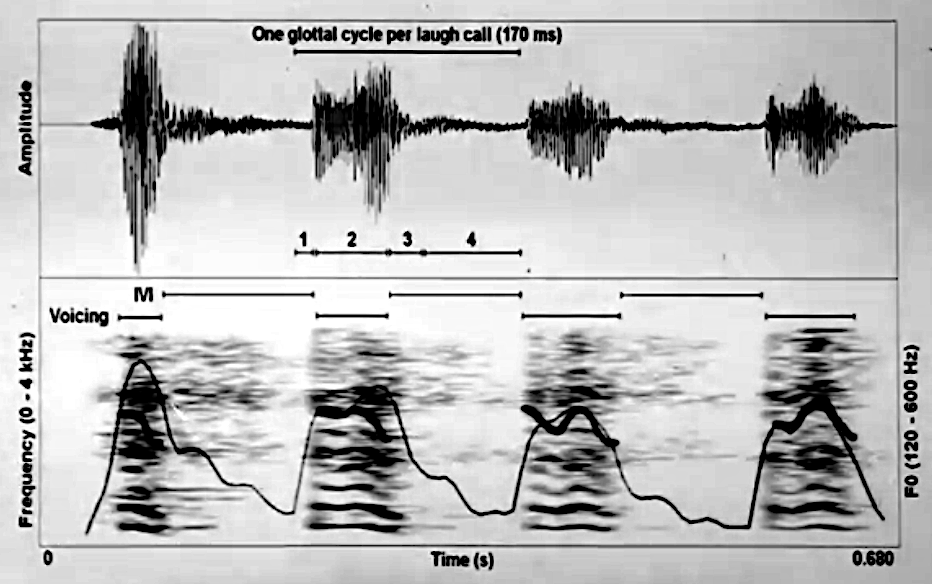
The sound waves of a typical laugh
Thats scientists for you. Interesting but not. He says that mammals for the most part all have some form of laughter, in rats for instance its ultrasonic, and if you tickle them, with the right equipment you can hear it. Also that we can detect with great accuracy when we hear two people laughing whether they are friends or not.
Bryant's explanation of why we laugh is to:
- Signal cooperative intent
- Strengthen emotional connections
- Signal decryption of indirect language
- Signal affiliation to overhearers
- Conversational turn taking and coordination
It is only when he finally summarises this by describing laughter as play vocalisations, that now i start to orient.
The science of play
Stephen Porges told us that play is a defining feature of the social engagement system, as mediated by the ventral vagus.
Play has been described as the brain's primary learning algorithm. It is how young mammals run safe simulations of consequential experiences. When children engage in rough-and-tumble and make believe they're not just having fun, they're building brain architecture. The prefrontal cortex, which governs executive function, decision-making, and social cognition, isseems to be formatively shaped by play experiences.
The theory says that play allows us to attempt behaviours beyond our current competence. We are rehearsing responses to novel situations, but in a context where the cost of failure is low. This appears to be enormously important for learning, where encountering novelty requires a low-threat state.
And what is novelty and novelty seeking, if not learning. A quest for more raw material, diverse premises that can be combined in new ways. This is indeed the definition of a joke. Familiar things put together in new and unfamiliar ways. Eerily that sounds exactly like the basic model of how the brain learns things.
Stuart Brown in his book Play, How It Shapes the Brain shows us that play integrates multi sensory learning in a way that formal instruction does not. When a child plays they are rehearsing narrative structure, empathy, social roles, and cause-and-effect reasoning. Brown's work emphasises that learning is state dependent, that our emotional and physiological state impacts whether deep learning is possible. Being self-directed and intrinsically motivated are also important. You cant make someone play. If curiosity drives learning then play naturally seeks the edge of where our most productive development and learning occurs.
Play also is where we develop and hone theory of mind (TOM), ie how we understand that other people have different beliefs, desires, and perspectives. Children who play more, particularly imaginative play, develop theory of mind earlier and more robustly. This is also why both solitary confinement, and play deprivation in young mammals (eg Harry Harlow's work with monkeys) produce such severe and lasting social and cognitive impairment.
Laughter then is a cue that what we are doing is play, and for the avoidance of doubt, not dangerous to our nervous systems. This in turn maintains the psychological safety that makes the learning mode of play possible. Brown's central argument, is that play is not a luxury but a biological necessity. Crucially he also makes the case the play is as important for adults as it is for children.
Making sense?
Firstly, this makes me see novelty a bit differently. If laughter is unexpected social surprise, a sort of novelty detection circuit, then the resulting novelty seems to amount to a new twist on familiar first principles. Which is how we define both learning, and the emergence of 'new' ideas. New permutations built from old material.
Secondly, the connection to theory of mind, and the social engagement system. It seems that the default mode network, what the brain does when it has nothing else to do, is highly focused on social relations and social identity. This i find interesting.
Thirdly laughter and play are embodied experiences. You cant think your way into or through it. Cognition or meta cognition, and play are almost the definition of totally opposite things.
Remaining questions*
Now. I am left wondering how play mediated learning experiences compares to threat based learning experiences. Some of the most important preconditions for neuroplasticity are attention, salience and the presence of emotion. We learn when situations are highly relevant to the needs of the nervous system, which produces both focus, and some sort of emotion. Its clear i think that two quite different versions of these conditions occur. The developmentally juicy, happy, safe, probably social, do more of this dude, version. And the, threat, survival, this is unpleasant version. Either way the brain learns.
However, there seems to be some key differences.
Threat-based learning is extremely effective for certain things. High arousal and amygdala activation is generally understood to produce fast, durable, highly specific ie. narrow learning. The leaves of that particular plant will kill me. I fear and avoid person X because they are critical. However this kind of learning appears inflexible and doesn't transfer well. It creates a narrowing of vision, and limits the range of responses. It helps us not one little bit for dealing with novelty. And, yes, novelty is increasingly a feature of our life.
Developmental play state learning, by contrast, employs what Barbara Fredrickson called broaden-and-build. It seems to create broad, flexible, transferable learning because the relaxed attentional scope pulls in a wide range of contextual information, nuances and complexity. They seem to be organised around an iterative pattern of approach, extend, repeat, all of which promotes reward. As a consequence, recombination gets enhanced. Novel associations form more freely because default mode network and hippocampus activity are less suppressed.
I mean, this is the state of the theory, such as it exists, but i am not sure that it yet completely satisfies me. If the standard plasticity model says: salience + emotion + attention = synaptic change, then surely both threat and play satisfy all three conditions. So why does valence matter if the preconditions are met either way?
One answer might be that older brain circuits tend to be black and white. Good bad, safe dangerous. They are fast and effective for survival. The newer brain circuits are slow and nuanced. If safety is a precondition of play and learning, then this way the PFC can work at its best in order to process all the new incoming novelty and do all the required slow computing of permutations and new neural associations. Hmmm, when i get A, B and C friends together its generally a good time. Throw in D and E and gets a bit wild but still fun, but B and D without A can get messy. C and E have a thing going on. And so on.
Play based learning is thought to encode prediction error (the gap between what the brain encounters and what it has previously learnt) more richly. The brain is asking "what's interestingly different here?" This is why play produces better generalisability and creative application to the edge cases we might encounter.
So survival learning as narrow, and narrowing, and developmental learning as broadening. More premises, more permutations. More possible futures. Thinking of it this way, maybe threat based learning is for self-preservation or evolutionary conservation. And play based learning is for expansion, and evolution. Both are plastic, but one looks backward, the other looks forward.
And returning full circle to laughter, if we take Porges' theory literally, then laughter helps suppress threat activation. Porges called this the vagal brake. This makes laughter as well as being a social signal, a homeostatic regulation tool. Laughter, like appreciation, as mutual co-regulation.
So it must now be clearer that when Porges says being socially engaged is a precondition of learning, he means developmental learning. The two systems are in tension, and importantly, unmanageable threat doesn't just suppress play, it arrests our development.
For the minute, I imagine fear based learning, as a phylogenetically older set of machinery. Its an interesting way to frame this puzzle. Evolution preserves what worked, and was useful for survival in the stable and slow changing threat environment that was more common in the evolutionary past.
Understanding play based learning as evolution itself, as expansive and future looking,. Perhaps this is how we can try to get ahead of, or at least keep up with, our environment rather than merely following it by several million years. Engaging with the process of our own evolution. How is that for a riot!
Lastly this seems to make our capacity for laughter under mild pressure a form of developmental resilience. Not happiness for happiness sake, nor the absence of difficulty. But the capacity to process novelty as interesting rather than threatening.
The science is currently still rather incomplete in this area,. No surprise there, we still don't have a full map of the vagus nerve never mind even half an understanding of what it does. So perhaps that just leaves us as inquiring practitioners, to experiment in our practice work and see what it can teach us.
Note that views expressed in blogs do not necessarity reflect the views of the Project. They are the blog authors version of truth.

