Blogs
Towards a context for feedback
On Context
The project is currently creating a feedback guide. Given it seems like a complex issue, one thing i can say with certainty, it that it isn't really clear what the definition of feedback actually is. A pod meeting on the topic opened the topic up with this:
- For some there is a desire to hear how they come across, how they impact people, as part of their personal growth.
- For others there is a preference to hold the AR frame of welcome everything, not attempting to fix others, and, that skilful impact is still a work in progress for most.
Growth verses safety. On the one hand an evolutionary impulse, and on the other a regulatory impulse. The former as the energy of a sprouting seed pushing through the soil, and god willing, developing the resilience to weather the vicissitudes of the environment. The latter as: I want the safety and acceptance of a nice warm greenhouse to grow at my ultimate best. Quite the paradox. Or is it?
The curious paradox is that when I accept myself just as I am... then I can change. -- Carl Rogers
I think the group is coming to see this duality, not as opposites to be reconciled, but as coexisting drivers that can be mediated with sufficient context. The obvious context is well, consent, right? (For which we have Betty Martin to blame for the C word being on the tip of our tongues lately).
More context might be about being trauma-informed. Those of us with tattered nerve endings benefit from a bias toward appreciation in order to be able to better maintain a window of regulation, such that any of this work is even remotely possible. That the relationship is sustainable.
Still more context, might be the AR maxim "When in doubt is my share in service of connection". Of course i am now struck by how Polyvagal this sounds.
PVT constructs a map something like this: Connected = social engagement system = ventral = regulated. (eg see here )
These contexts speak to the central imperative of regulation. Consent embodies choice, and choice is critical to safety. If the feedback target invites the feedback, they are more likely to be receptive to it. If the feedback giver is regulated then the feedback is more likely to be delivered with care and skill. When regulated we have the cognitive resources to remember our training, to moderate disowned language, to ensure our intention is aligned with a context of care, and ensuring our feedback is delivered in the way that the target can best hear it.
My July post on the subject derived , from first principles, this phrase "Only give negative feedback with consent, or by invitation". The word negative is used here in the sense: implies room for improvement, or that may not feel good to receive, rather than feedback that is bad, wrong or mischievous.
Anyway, as a result of the project's inquiry i think there is quite a bit of room to improve upon that first pass aspiration statement's phrasing. But first, shall we take a look at some terms?
What do we mean by 'negative'?
I would love to share why this term is a good fit for me. In the science of emotion, the entire gambit of human feelings has been catalogued on a quadrant with two axes: arousal (high or low) and valence (negative or positive). This is known as James Russell's Circumplex Model of Affect/.
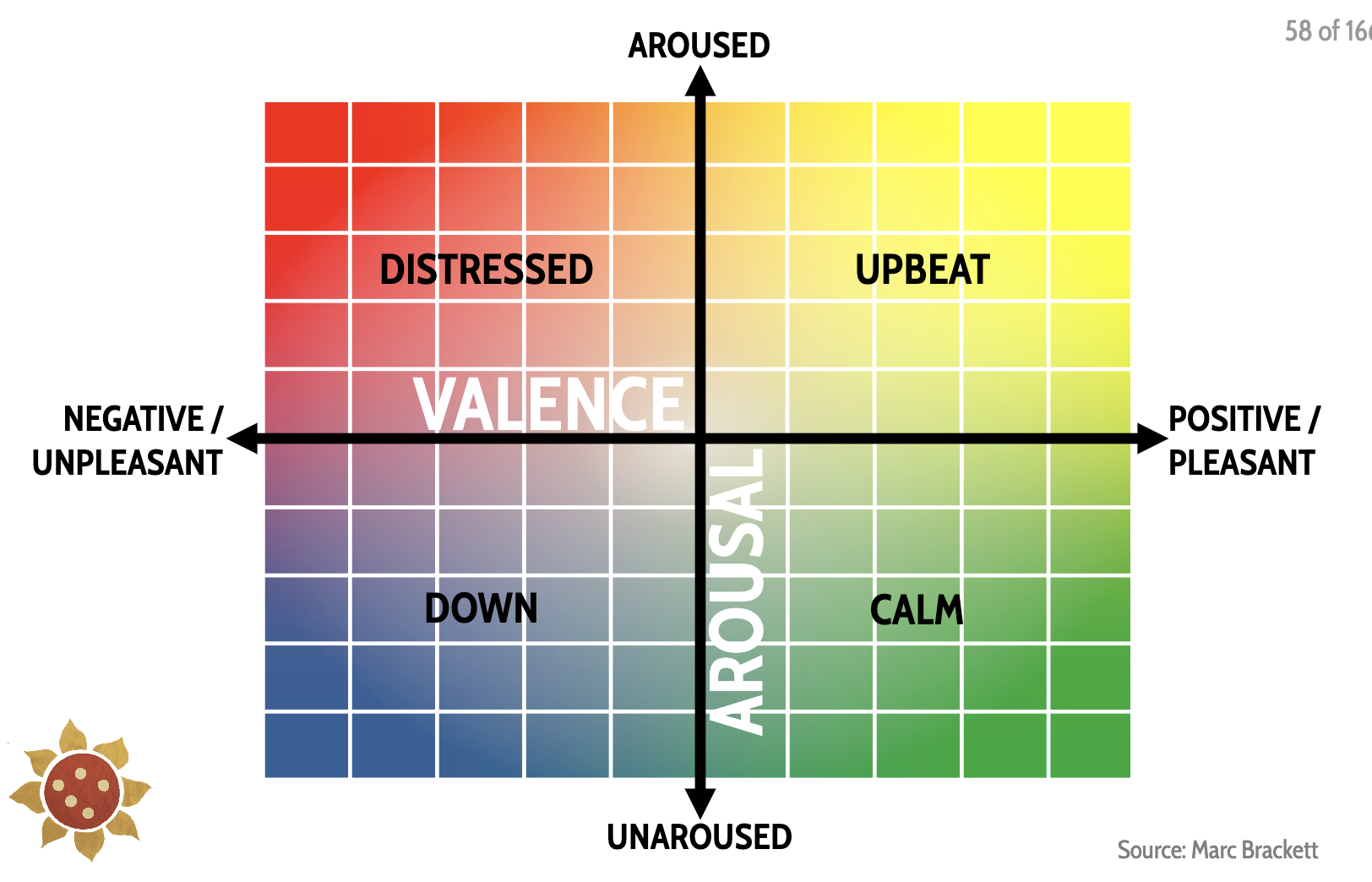
Of course i'm now struck by just how much PVT i see in this diagram. Porges has a way of reducing things to their simplest, on regulation he said: does it feel good or does it not feel good. On the left side we have dysregulated. On the right side regulated. Sympathetic is top left. Dorsal is bottom left. And the entire right side is all ventral, with the right bottom being perhaps the new frontier, one of meditative calm, of equanimity and consciousness. Its a quadrant that today is sparsely populated by named emotions, precisely because our species is only now beginning to evolve into that quarter.
So this is what i mean by negative. To me it is not about intent, or about right or wrong. If we want to be as clear as we possibly can about the term we probably need to get into the weeds a bit. So lets look at a pair of examples, both of which i file in the negative camp.
Imagine that someone says to a call host: "You kinda messed up the breakout room timing a bit.". From a purely language point of view, there is room to improve our ownership here, right? (Although, PVT tells us that it's success will depend almost entirely on whether the speaker is laughing or scowling.)
If we were to go more of a Nonviolent Communication (NVC) route, we would lean more into emotion and use i statements. We might get "I felt a bit lost with some of the breakout timing."
But we can go further. By adopting an regulatory AR frame, we might add: "...but then i realised we are all just learning, and i had a laugh about us all being beginners playing in a sandpit". Now here we have a feedback that is linguistically clean, and, AR through and through. But, as the speaker, we cant really help but say this sort of thing with a smile. What i just love love love about AR is that not only does the language co-regulate the listener, it also self-regulates the speaker. If you ask me that's really powerful medicine.
Here's the second example. Let's say someone gives, as unsolicited feedback: "I am not feeling heard".
Negative or positive? On the one hand it contains the word feel, and sounds like an emotion statement, but in NVC terms it's not a true feeling word, it's what Rosenberg considered a pseudo-feeling. It infers a judgment about the other's behavior (you're not hearing me), rather than the speaker's actual felt sense (I feel sad, lonely, discouraged, frustrated, etc).
So linguistically, even if unintended, that language subtly positions the recipient or target person as the cause of my discomfort. That's why it tends to land as negative feedback rather than just the sharing of impact. But again, we must ask: when i say something like this, what is my blood pressure, what non-verbals am i employing? Any verbally unexpressed frustration is, to their neuroception completely transparent. Not only do they detect the verbal / non-verbal discrepancy (in itself troubling), but their primitive mammal brain hears the implicit frustration as: this person doesn't like me just now. Am i about to be abandoned, or cast out?
In relational terms, "I'm not feeling heard" says, in the fine print: "You are not listening to me". And, it tells the target nothing explicit about what you want, thus giving the target no obvious pathways to support you. Instead it leaves us both in a puddle of muddle.
Upon further contemplation, the most troublesome feature of this kind of feedback is that because it's born of an emotion/language mismatch this already hints at the presence of dysregulation, be it small or large (the current science tells us that we can only notice our meta level experience when we are regulated). So now this dysregulation biologically, from a survival point of view, literally compels us to override our agreements to "own our experience", and to "seek consent before giving feedback". This kind of feedback is often spontaneous emitted rather than considered or invited. That's where the difficulty really begins, and it is capable of setting off a cascade of grumpiness in an entire room full of people.
In a sense, this is so common, to the point of 'normal', but from a nervous system point of view, it is clearly far from ideal. Lets be clear, this is not to say that it's in any way badly intended. In EFT this phenomena is called 'protest' behavior. In NVC, it's considered a product of unmet needs. Of needs that haven't yet been noticed or claimed.
Alright, lets give this example a makeover as well. A really good NVC version might be: "I'm feeling frustrated, and sad that i cant make myself clear here". Now owned, with true primary emotions., it's vulnerable, thus invites empathy, and by introspectively naming we are now well on our way to some regulation.
For the AR version, how about: "I'm noticing that there is still a piece that i would really love you to know about, and that's... X, how does that land?"
Alright then. Putting our working definition of "negative" together so far, we might get: "We define negative feedback as corrective or dysregulated in nature, regardless of intent. This includes impact statements that are not owned, that imply someone has done something wrong, or that may not feel comfortable to hear."
What about the term constructive feedback? Actually i don't think there is such a thing!
We've said this before and we'll say it again: there is no such thing as "constructive criticism." Criticism is always destructive. - Julie Gottman
Polar Opposites
At this point, i find myself faced with a provisional construct that says that uninvited negative feedback, and "expressing desire", are polar opposites.
Negative feedback tries to change the other, whereas expressing desire reveals ourself, and thereby expands our relationship. In that sense this more relational approach seems very apropos to our mission.
Lets compare these two styles:
| Mode | Language | State | Effect | Intention |
|---|---|---|---|---|
|
Negative feedback. (launched uninvited). |
"You kinda messed up" | Mobilized / defensive. Unidentified need. | Protects self, risks separation | Protest / unclear. |
|
Expressing desire. (offered by consent). |
"May i tell you what i love about clear timing?" |
Regulated. Identified desire. |
Invites connection, supports agency, builds relationships, co-regulation |
Personal and group development. |
And thanks to this discussion, I now have a solid 'why' for the practice of welcome everything. I was clear which kind of feedback felt more juicy, but I didn't understand why. I was just following in the footsteps laid by my AR mentors.
The question becomes: how
Lets not confuse our definition of negative feedback with that other thing, ie skillfully delivered insight that offers a mirror into the recipient's world. All schools of feedback hold precious the value of the mirror to our development. But the emphasis is on the words: "skillfully delivered". Even a moderately focused practitioner will quickly reach a place where they want to know how they come across. Then, and only then will they ask for it. Then they will welcome it. Then they will be able to hear it, and use it to grow.
The best i have right now is that if feedback is to be constructive it must first be invited and/or consented, and then delivered from a place of regulation, using owned and relational language. I want to look at this in more detail in part two.
Conclusion
As for that greenhouse metaphor. A greenhouse has no wind, and it is the wind that creates the stress that gives the plants their resilience, and strength. My working conclusion on all this is that relational stress is unavoidable. It is coming, ready or not. Either by an intentionally created hormesis informed context or by the simple mechanism of homeostasis (aka. the universe gives us the amount of stress that we can handle), it appears that when we enter the world of relationship, we will get all the stimulation we need.
Before writing this i did a literature search, and it turned up surprisingly little. It's possible there's an undocumented body of knowledge out there on this matter, but it's equally possible that feedback is part of the bleeding edge of relational evolution.
In short, i have this sense that feedback is about knowing when to hold space (welcome everything), when to offer skillful impact (leaning into our edges), and how to consciously co-create safety before stepping into the complex realm of the trying to (helpfully) illuminating blindspots.
Note that views expressed in blogs do not necessarity reflect the views of the Project. They are the blog authors version of truth.

