Blogs
The circle of safety
Introduction
While researching Biochemistry of leadership i happened upon Simon Sinek's concept of Circle of safety. It's in chapter three of Leaders eat last.
He introduces the idea by describing the way US marines are trained to work in teams. He explains that marines are better able to face external dangers when they have no fear of danger from each other.
From this day on, [the drill instructor] shouted, words like 'I,' 'me,' 'my' will no longer be in your vocabulary. They will be replaced with words like 'we,' 'together' and 'us.'"
--Sinek
His 'circle' is a sort of force field he draws around the company, to protect it from the harsh realities of the outside world. A clan of cave dwellers huddling around the campfire, the circling of wagons in the wild west. Protecting the group from predators, hostile outsiders, and actual death. The circle of safety says that, in business death is: the vicissitudes of the stock market, 90% of new businesses fail, corporate raiders, mergers, layoffs, etc etc. And the way to protect the company from all those outside threats is to attend to the internal relationships first.
A circle of safety is the absolute confidence that someone will be there for me, and so in return, it's natural human instinct, I will be there for them.
-- Sinek
That we look out for the person beside us, to me speaks directly to co-regulation. Nervous system science tells us that when we as individuals are under extreme threat, we lose the capacity to function well at anything, never mind being able to collaborate.
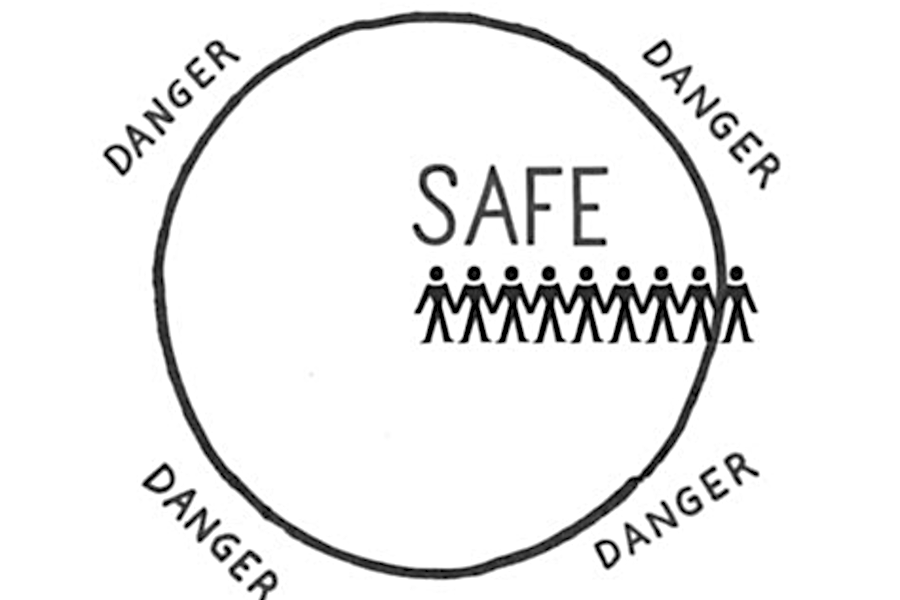
In that sense the circle is not agreement, niceness, or the absence of conflict. It's a shared sense that vulnerability is OK, that mistakes won't lead to exile, and that relational rupture is survivable.
In this video Sinek explains his concept in three minutes.
Whatever we might think about the insanity of military spending and corporate capitalism, there are two striking aspects to hearing this story come directly out of the mouth of a business leader.
The circle as practice
The first is that it speaks to the very definitional tension i spoke of in biochemistry of leadership. That is to say, we need to be clear which of the two meanings of the word practice are we referring to.
Instead of taking the AR approach of practice, learn and grow outside of day to day relationships, these inspired business folk are trying to walk the talk. Day to day work as their practice. By taking this bold new teal inspired approach of putting relationships before work outcomes, testing it in the one place we spend most of our waking hours, learning by trial and error, this certainly speaks to practice, sure it does. But i see it as a different definition of practice than we have in AR, or you have learning to play the piano. The latter is more the deliberate repetition of drills outside of day to day life, outside of the actual performance.
I find this alone interesting, because enthusiastic AR practitioners find it hard to get enough opportunities to practice. On a good week 6 hours of formal practice would be doing very well. And expensive. Training providers like TRC charge USD4000 for this privilege. But these business innovators are getting 40 hours a week for free.
I know that i am over simplifying here. Obviously Sinek's circle hinges on the presence of enough inspired leadership to catalyze just such a workplace environment, and few actual businesses have yet adopted his ideas yet. Also, there are significant benefits to titrating practice in measured smaller doses, instead of being thrown in the deep end, to either sink or swim (as you are in marriage, or at work).
So the circle of safety speaks to the notion of innovative business team work as a practice arena. Different to the hero's journey of AR practice. Both seem valuable. Both have strengths and weaknesses.
The circle as attachment

The pair bond is thought to be a unit that provides a secure base in which to explore and develop (possibly beyond it?)
The second striking thing about this circle idea is that i cant help but notice that it sounds distinctly attachment informed. In the sense that it overlaps the social bonding narrative developed at length by John Bowlby, in theory, then later by the likes of Sue Johnson and Stan Tatkin, in practice.
Attachment conventionally plays out in two primary arenas, the infant-caregiver bond, and the pair bond. Attachment was thought to have evolved in that order. But we know that the hormone, oxytocin, which powers attachment, is now capable of acting more broadly. Because we see it extruding to both nuclear and extended families, and beyond those into other intimate applications like sports teams and support groups.
Here Stan Tatkin talks about what he calls the couple bubble:
"The couple bubble... describes the mutually constructed membrane, cocoon, or womb that holds a couple together and protects each partner from outside elements.
A couple bubble... implicitly guarantees such things as:
- I will never leave you.
- I will never frighten you purposely.
- When you are in distress, I will relieve you, even if I'm the one who is causing the distress.
- Our relationship is more important than my need to be right, your performance, your appearance, what other people think or want, or any other competing value.
-- Stan Tatkin
This is a big subject (and risks detouring us from the theme of this post). But its basically the idea that humans evolved to attach, to gather together deliberately in kinship groups. This is the source of the cognitive bias we know of as the in-group bias. For example we profoundly mourn the death of a loved one, but are oblivious to the plight of millions of people dying of hunger in some far flung third world country.
That's attachment, its neither right or wrong, its just how we as mammals evolved.
To further connect this attachment framing, i imagine that Sinek might possibly have borrowed his term from a related program called the Circle of security
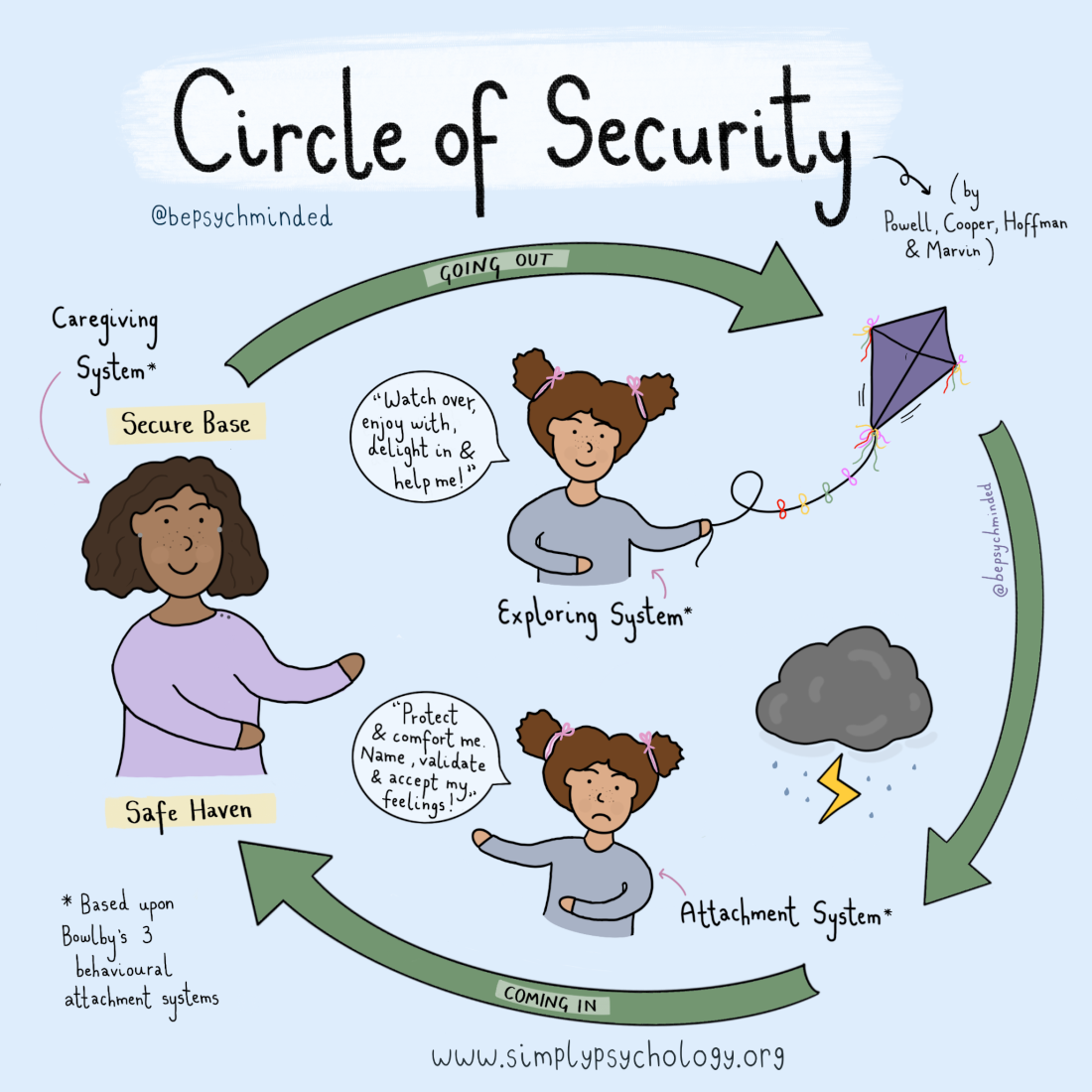
The circle of security is a teaching tool used for new parent education and intervention programs to help caregivers understand and meet their children's attachment needs. It speaks to the interplay between a child's need for exploration (going out) and their need for comfort and safety (coming back). Secure base, and secure haven, to use Bowlby's terms.
So we see Sinek's circle as an attachment informed extrusion from the couple or parent-child relationship to the small group or team. From the world of family to the world of the workplace.
Lessons
This belonging circle is a concept the project anticipated. The vision booklet speaks of creating a new type of social unit comprised of small human scale support and learning pods (p4).
As a hypothesis, that perhaps it's possible to evolve beyond the limitations of attachment. Yes, attachment provides the safety we need to grow. But it also brings in-group parochialism and oblivious disregard of out-group. While attachment has traditionally been enacted within the context of the nuclear family, the project offers small team work as a bridge or stepping stone to a possible future where relating might apply the same between all humans.
I think many of us intuit the sense of juice of practicing these fairly vulnerable conversations with complete strangers. Perhaps this speaks to some kind of pregnant evolutionary longing expressing itself.
If we can learn to relate skilfully with strangers with care and insight, not only might we learn to relate with ourselves with more mindfulness, but maybe by extension we start to relate with all other creatures that live on this planet too. Or as the Practice Primer alludes, to the Integral big picture of extending even further reaching into even greater cosmological realms.
But before we get carried away and drift off into the clouds, perhaps we might master attachment, and bring as much mindfulness to our group work as we can, and see what that teaches us, see what potential there is to shed our relational wounds. In the overall scheme of things, this sounds like a great place to be right now.
Note that views expressed in blogs do not necessarity reflect the views of the Project. They are the blog authors version of truth.

