Blogs
Feedback in the business world
Our journey to better understand feedback, and towards some kind of protocol, warrants a deeper look into the literature. To do that, i guess we have to look at best practices from the business sector, because that's where the bulk of the trial and error is actually taking place.
Feedback is something the corporate world has long been fascinated by. Firstly, the studies. Three of the most most widely cited, are these:
- Kluger & DeNisi (1996) - feedback has inconsistent results; better when focused on the task and less on the person.
- Buckingham & Goodall (2019) - feedback is a fallacy, people can't reliably rate the performance of others, more than 50% of your rating of someone reflects your own characteristics, not theirs; criticism provokes the brain's "fight or flight" response which inhibits learning.
- Anseel & Sherf (2025) - the science of feedback is incoherent, feedback is often generically defined, and assumptions substantially diverge.
Buckingham et al's approach is strengths based, and positive weighted:
Learning is less a function of adding something that isn't there than it is of recognizing, reinforcing, and refining what already is... People grow far more synaptic connections where they already have the most synaptic connections. In other words, each brain grows most where it's already strongest...
The strong negative emotion produced by criticism inhibits access to existing neural circuits and invokes cognitive, emotional, and perceptual impairment... Focusing people on their shortcomings or gaps doesn't enable learning. It impairs it. In the brains of the students asked about what they needed to correct, the sympathetic nervous system lit up, which mutes the other parts of the brain. In the students who focused on their dreams and how they might achieve them, what lit up instead was the parasympathetic nervous system... The parasympathetic nervous system... stimulates adult neurogenesis (i.e., growth of new neurons)..., a sense of well-being, better immune system functioning, and cognitive, emotional, and perceptual openness.
-- Buckingham and Goodall
While their article went quite viral at the time, it has since attracted considerable debate. Which we will come back to.
Anseel et al is a comprehensive recent meta-review of the current state of the tool we call feedback. What struck me most about this study is that the term 'feedback' appears to have no commonly agreed definition. That in itself is problematic.
In this post i want to look at various attempts to gain clarity on the matter, at least in the business sector, and then try to draw some conclusions.
360 feedback
No discussion of feedback would be complete without touching base with 360 as it is widely employed in the corporate world. It's called 360 degree feedback because it comes from all directions, from your managers above, your subordinates below, your colleagues beside you, and from yourself. It's usually carried out annually, and to allow speaking freely the feedback is anonymous, so as to remove the fear of punishment.
In Laloux's model this would be an orange tier tool. 360 assumes hierarchy, it assumes that the design of the questions and the administration of results are driven by HR departments and managers. Fittingly it is thought to have its origins in the German military during WW2.
With its multiple perspectives it's an improvement on whatever came before it, but it's generally accepted that there are shortcomings. Carol Sanford's book No More Feedback explores these at length. Sanford's books are required reading in today's business schools.
Sanford did a number of interesting studies with children, that suggested that no amount of feedback changes the result. It was only when the test subjects were given control over how the experiment was conducted that improvements occurred. This led Sanford to believe that people perform best when they operate with an "internal locus of control". In other words they want to learn, grow and excel not because of some external authority, but for their innate longing for agency and self-improvement.
At this point i will just note that she takes a rather hard line, that the only feedback that matters is self-feedback. "Am I actualising my unique potential in service of something that matters to me?" Probably lots of scope for push back against this.
Agile retrospectives
But like all things, change is the stuff of life. LaLoux describes the shift from orange thinking to green in the business world. Green is about the idea of family, so team work, less linear, more network based communication, and the idea of dynamic trial and error replaces heavy centralized planning processes. The feedback tool that emerged with agile is called the 'Retrospective'.
Agile is a bigger subject best covered separately, suffice it to say that work is broken up into self-managing, relatively autonomous teams that operate using a 1-2 week sprint cycle, of defining goals, carrying out plans, then reviewing at the end of every cycle. In this way feedback is much more frequent and used to inform incremental improvement. Its also focused on the team and its project, not so much the individual. The process asks simply: what worked, and what might we improve next time.
The basics of this more team focused approach are:
1. Psychological safety first
2. Focus on the system, not the individual
3. Action or future orientation
4. Combining quantitative data with qualitative storytelling
5. Frequent rhythm
Feed forward
Interestingly the word feedback comes originally from the engineering world, and the word 'back' emphasizes looking backward.
As a result a term "feed forward" was coined to describe a feedback system that keeps the goal or vision front and center. Instead of tearing down, finding fault, or re-litigating the past, its about progressing the vision and allowing people to thrive while doing so.
With feed forward you describe a behavior you want to improve, then ask colleagues for two suggestions for the future. Key rule: you can only say "thank you" no explaining, defending, or critiquing the suggestions.
S.B.I.
SBI (Situation-Behavior-Impact) is kind of NVC for business. Its a feedback framework that structures feedback offerings into three components:
- Situation* - the specific context (time, place, circumstances)
- Behavior* - what the person actually did or said (observable, not interpreted)
- Impact* - the effect it had on you, the team, or outcomes
Example: "In yesterday's client meeting (situation), when you interrupted Sarah twice while she was presenting the budget (behavior), the client looked confused and Sarah seemed to lose confidence (impact)."
This approach keeps feedback concrete and factual rather than judgmental and personal. It separates what happened from your interpretation, making it easier for people to hear and act on.
Psychological safety
In part one Towards a context for feedback, i described the projects twin (conflicting or otherwise) imperatives of safety and regulation on one hand, and growth and development on the other hand.
So let's throw another term into the melting pot: accountability. Amy Edmondson studied airlines and hospitals and the like, to try to find out why in some high stakes environments critically important information wasn't being communicated. An example she cites is where a nurse who noticed a drug dose typo feared correcting the doctor, because the doctor had previously scolded her for not staying in her lane.
Edmondson noticing how these organizations had a prevailing culture where it was unsafe to give feedback, coined the term psychological safety. But this left many with the obvious rejoinder, well that's all very good and well making these nice safe places where there is no fear, but how can we hold people accountable?
Her resolution, is that its possible to do both. Neither safety nor accountability is the end goal, they're both environmental conditions that enable development.
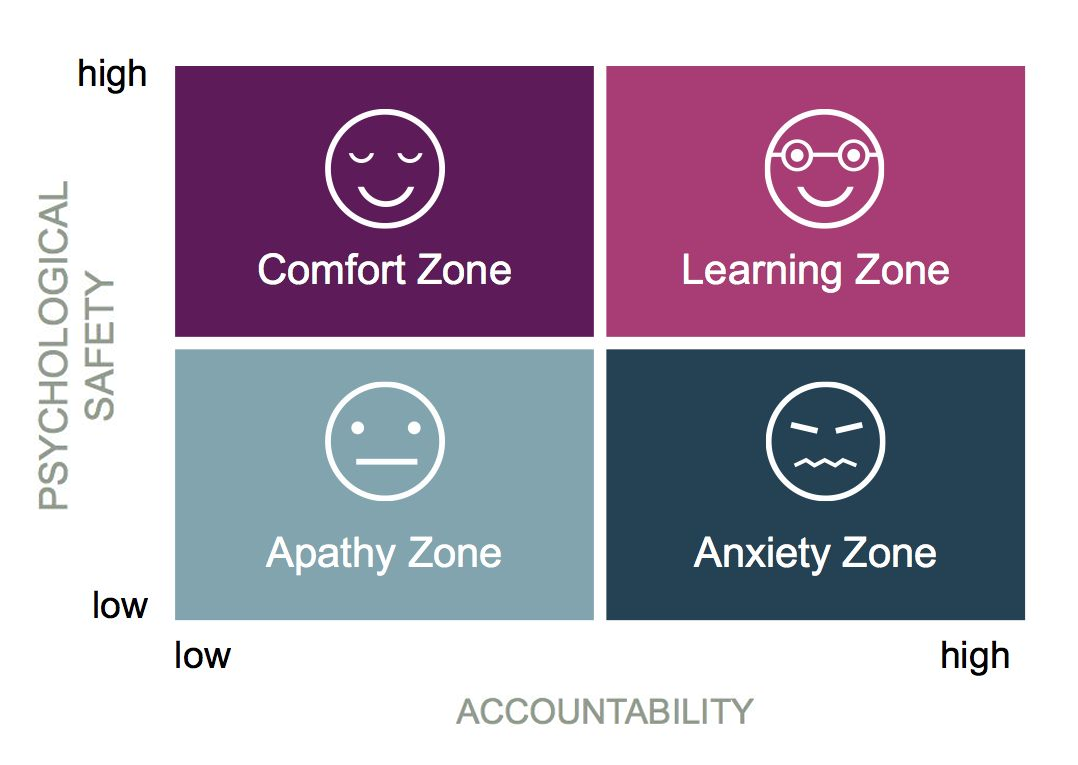
The idea here is that a process with lots of fear will not produce results. Nor will a process that is too comfortable or stable. Here again is this hormetic stress principle, which i talked about in Hormesis as a lens.
The myth of the self-regulating individual
And here we see another limit of Sanford's model, that it is premised at the level of the individual. Conversely AR factors that there is a 'we', or a 'field', which seems neurobiologically aligned even if it doesn't name it as such. Put another way, the social nervous system, instead of magically expecting the individual to regulate (as a precondition for growth).
This is of course the essence of Polyvagal theory, with it's notion of co-regulation. "Co-regulation creates a physiological place of safety where the autonomic nervous systems of two or more individuals find sanctuary in a co-created experience of connection". This, to me, implies that pro-regulatory feedback is supportive of being in relationship.
"Feedback is hard. We fear we'll mess up relationships, get it wrong, or that we're awkwardly imposing a sort of power imbalance by sharing our observations about another person that may suggest we're better at it than them.
But feedback is powerful. It empowers self-awareness, learning, and growth. If given correctly, it fuels curiosity.
I believe being so binary to suggest that positive feedback = good, and negative feedback = bad, is reductive. And I think we can do better.
-- Sophie Edwards
Looking to the future
So far, we have a spectrum of ideology, from more external to more internal, more evaluative to less evaluative:
- Traditional 360s (hierarchical, anonymous, evaluative)
- Laloux (peer dialogue based, developmental)
- Buckingham et al (strengths based)
- Sanford (purely internally referenced)
Its fair to say i think that Sanford's view is generally considered rather utopian. If we were all perfectly self-aware, and self-motivated, I am sure that it would work splendidly.
However if we were to start from Buckingham et al's strengths based approach, then add a design Sanford articulates in Chapter 12, where the feedback plan is created by the recipient. Targeting self-development, it involves both self-reflection, and an invitation to select others to share their reflections, knowing that their reflections are subjective. So basically she is adding the the notion of consent.
Perhaps modern disciplines like authentic relating also offers hints at this new design. AR is rooted in the idea of reveal and own your experience. I love the way you... and I hold dear the value... I would love to... and see us do... Which then becomes an iterative inquiry that is mutual, experimental, pro-regulatory, and developmentally self training. Most importantly, in this way, AR factors the relationship. This kind of feedback (if it could even be called that), is maybe even itself a practice. Not so much a means to an end, but an end in itself.
Getting our hands dirty
What does all this look like in practice? Here is a few ideas from Retrospective style feedback:
- Start, Stop, Continue* - What should we begin doing?, What should we stop doing? What's working that we should keep doing?
- Starfish*: Keep doing, less of, more of, stop doing, start doing
- 4Ls*: Liked, Learned, Lacked, Longed for
- Sailboat* - Wind in the sails (what's propelling us forward?), Anchors (what's holding us back or slowing us down?), Rocks (what risks or obstacles lie ahead?) Ports (where are we trying to go?)
These variously map to our old standby, Rose bud thorn, more or less (what we learned, what we might do differently, what we liked).
So to wrap up, here is my take on the practices that might bring our feedback aspirations to life:
1. Consent / invitation - only offer feedback when the other person wants it.
2. Regulated state - give feedback only when you are regulated enough to stay warm, grounded, and connected.
3. Be specific - describe concrete events, or behaviors, not personality traits or generalizations.
4. Adopt owned framing - Use I statements, eg 'I liked' 'I loved' rather than 'You did' 'You were'.
Where there is explicit consent to give feedback on "room for improvement", adopt these additional practices:
1. Express in the affirmative - say what you would like to see, rather than what didn't work. eg "I'd love to see you..."
2. Critique first, praise second - follow your 'What i would like to see you do...' with at least three 'What i liked...'
3. Invite impact - check by asking "how that was to hear", and make a space for their response.
4. Clean up - If, as a product of this feedback, there is an upset, lean into repair promptly.
Reading:
- Buckingham and Goodall (2019), The Feedback Fallacy
- Ansell and Sherf (2025), A 25-year review of research on feedback in organizations: From simple rules to complex realities
- Sanford, Carol (2018), No More Feedback
- Edmondson, Amy (2018), The Fearless Organization
Note that views expressed in blogs do not necessarity reflect the views of the Project. They are the blog authors version of truth.

